



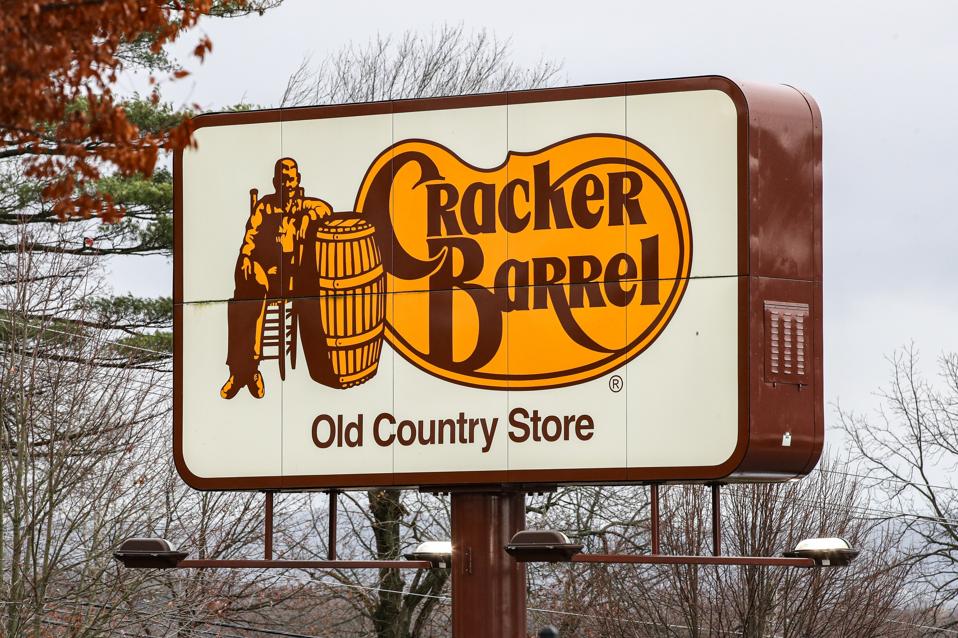
The rebranding efforts by the Cracker Barrel restaurant chain that caused a crisis for the company offers important lessons for corporate executives about how changing a corporate logo can create a self-inflicted public relations crisis.(Photo by Paul Weaver/SOPA Images/LightRocket via Getty Images.
Cracker Barrel’s crisis started when it removed from its logo a barrel, an image of a man leaning on the barrel, and the tagline “Old Country Store.” It also used a more modern typeface for the restaurant’s name But days after launching the new logo, the company backtracked and restored the old one. “We thank our guests for sharing your voices and love for Cracker Barrel. We said we would listen, and we have. Our new logo is going away and our ‘Old Timer’ will remain,” the company said in a statement Tuesday on its website.
A Textbook Case
"Cracker Barrel’s rebranding offers a textbook case in how legacy brands can stumble and recover when modernizing their image. The company’s minimalist logo stripped away iconic symbols that had anchored its identity for decades. Its step toward modernization quickly sparked outrage that social media and conservative commentators fanned by labeling the rebrand as a cultural concession. Shortly after, the company’s stock slid, erasing millions in market value,” Usha Haley, an expert in business strategy and Barton Chair in International Business at Wichita State University, observed in an email message to me.
Business leaders should keep in mind the importance that logos have in the minds of consumers, and the risks and ripple effects of changing corporate symbols.”Cracker Barrel’s reversal is a classic pop culture branding lesson. In today’s climate, logos don’t just live on storefronts—they live in memes, TikToks, and late-night commentary. The company underestimated how quickly a logo change would get pulled into cultural debates and politicized online. Once something becomes a pop culture talking point, the backlash multiplies,” Stacy Jones, CEO of Hollywood Branded, told me in an email interview.
Eliminating or changing images, fonts, taglines, colors, and other elements of a corporate symbol can also signal changes thatcan upset loyal customers. The rollout of Cracker Barrel’s new logo “stripped away the very heritage cues people emotionally bought into. Heritage brands can modernize, but when you erase identity icons, fans feel like you’re erasing them. In pop culture, that sense of erasure is what drives uproar, not just the design itself,” she observed.

Branding Decisions Carry Emotional Weight
“The key takeaway for business leaders is that branding decisions carry emotional weight. A logo isn’t just aesthetic, and a name isn’t just a word—both anchor memory and emotion. Cracker Barrel’s refresh fell short because it stripped away the very elements that conveyed tradition and familiarity, creating disruption and confusion about the brand’s identity,”Tatiana Dumitru, a senior branding specialist and founder of PRETEE Creative, a branding agency, told me in an email interview.
Executives should be careful about changing corporate logos in response to the latest trends.“Modernizing doesn’t have to mean minimalism and trends should never come at the expense of brand equity. Customers form strong emotional attachments to brand elements, and removing them can feel like the brand itself is drifting away,” she advised.
Company logos can hold deeper meaning for consumers, and are opportunities to convey information, background, and history about a brand. This is especially true when changing an established and well-loved brand. “Rebranding is about strategically telling a story. One that maintains trust with your core audience while simultaneously establishing trust with new audiences. Cracker Barrel missed the mark by underestimating the emotional investment their customers have in the tradition that the original logo represented. Now the brand doesn’t feel authentic. And the aesthetic doesn’t match the southern hospitality that customers have loved for five decades,” TaChelle Lawson, a culture and communications advisor and president of FIG Strategy and Consulting, told me in an email message.
Logos Are Symbolic
“Logos are more than fonts, color palettes and icons. They’re symbolic. They represent beliefs, expectations, and culture. When your brand identity is steeped in American nostalgia, your visual shifts better be backed by intentional messaging that connects the old with the new. Without that, you invite confusion at best and, at worst, suspicion that you’re abandoning your base or virtue-signaling for no apparent reason,” Lawson counseled.
Any efforts to change a corporate brand should not be undertaken without asking several key questions. “Brand changes demand cultural intelligence. You can’t afford to be tone-deaf or reactive. Before you roll out a rebrand, ask: Who are we evolving for? And how do we preserve trust in the process? If you can’t confidently answer those questions, pause on the rebrand,” she concluded.
The immediate backlash to Cracker Barrel’s new logo also underscored an important truth about branding. “Heritage is not an accessory, but the cornerstone of customer loyalty and trust. When brands strip away a visual identity, especially one as iconic as Cracker Barrel’s, it redefines how people identify themselves with their brand. While it’s inevitable that modernization will happen at some point with heritage brands, this kind of evolution can’t be thrust upon loyal consumers overnight because they’re more likely to feel ambushed than engaged,” Georgia O’Brien-Perry, a digital public relations manager at Bulldog Digital Media, told me via email.
What Not To Do
If companies decide to change their logo, they should do so very carefully, keeping in mind how attached consumers may have become to it, Cracker Barrel’s new but temporary logo “was a stark example of what not to do in modern rebranding: sleek, sterile, and completely disconnected from what makes them special.The backlash wasn’t just resistance to change; it was a powerful demonstration of customers protecting a brand they love from corporate homogenization. Their voices were heard, and they made a difference. Matias Rodsevich, CEO and founder of PR Lab, told me via email.
Businesses that change logos on a whim or without understanding the attachment consumers have to the corporate symbols can be asking for trouble. “Business leaders should take note: your customers are the backbone of your brand, and their loyalty should be at the forefront of any rebranding decision. Before any rebrand, ask yourself if you’re improving your brand promise or erasing it entirely,” he noted.
Not The First Time
This is not the first time that a company’s rebranding efforts created a crisis. “This is the same path we saw Jaguar take, where they sacrificed the brand heritage on the altar of being ‘hip’ to attract younger audiences,” Reilly Newman, a brand strategist at Motif Brands, observed in an email interview with me.
There should be sound strategic reasons for changing company symbols. “The lack of strategy is clearly evident as the [Jaguar] brand discarded its identity, which has become iconic, along with the store design that sets the tone of the branded experience. They failed to consider the impact of removing these elements to appear more modern, which led the brand to a digital-focused, bland personality that lacks soul,” he pointed out.
Best Practices
The rollout of Cracker Barrel’s revamped logo underscores key lessons for business leaders. “Heritage brands must tread carefully when altering familiar symbols tied to customers’ nostalgia. Transparent communication becomes necessary to contextualize change. And in today’s polarized environment, even seemingly small design choices can become political flashpoints,” Haley of Wichita State University warned.
Stacy Jones, the CEO of Hollywood Branded, recommended the following that steps business leaders can take to help avoid a logo-related crisis situation.
- “Evolve in chapters, not cliff jumps. Heritage icons should be updated in small steps, not overnight removals.”
- “Test for cultural heat, not just consumer preference. If you can picture your redesign trending as a negative meme, you’re not ready.”
- “Have a ‘heritage guardrail.’ Protect your 2–3 most sacred assets unless you’ve built in proof that fans won’t grieve their loss.”
- “Prepare for the pop culture cycle. Once backlash starts, you’re not just fighting design critiques—you’re fighting the cultural narrative. Quick, values-driven reversals are sometimes the only way to stabilize.”
There are additional steps that companies can take to help ensure a smooth transition to new corporate and brand logos. “When proposing changes, brands have to tell consumers why, acknowledge what will not change, and bring their audience into the process before its unveiling. Brands need to remember who they actually belong to, and that is consumers,” O’Brien-Perry at Bulldog Digital Media, advised.
There was a silver lining to Cracker Barrel’s logo crisis. ‘On the positive side, while the brand initially dismissed criticism, it pivoted relatively quickly when executives realized the public was standing firm, and reverted back to its original brand that the public knows and loves. I suspect they learned a lesson from the devastation that Bud Light suffered after making a similar mistake,” Jeremy Knauff, founder of Spartan Media, told me in an email message.
Executives who decide to change their company’s logo should ensure that their corporate crisis management plans include provisions for responding to backlash about the change. And don’t underestimate the power of social media and consumer sentiments that could force companies to reverse their rebranding efforts. Just ask Cracker Barrel.